Letter from the Executive Director
In last year’s report, I wrote about Farm Forward’s commitment to make the harms of factory farming impossible for the public and policymakers to ignore. That commitment has only deepened in 2025. Over the past year, our work has focused on connecting farmed animal welfare to concerns that are top-of-mind for many Americans: the safety and cost of the food they eat, as well as personal and public health risks. We told these stories convincingly, and the response to our work this year was unambiguous: millions of people paid attention, and tens of thousands took action to demand change.
Our research into the ongoing bird flu crisis shows how deeply the public health risks run. We revealed that when the largest poultry and dairy companies repeatedly cause avian flu outbreaks, USDA spends billions of taxpayer dollars bailing them out. Instead of requiring even the most basic reforms, like lower stock densities, improved genetics, or stronger biosecurity, regulators allow industrial operations to continue practices that endanger workers, raise prices, and keep the virus circulating. Our findings helped drive sustained national coverage in The New York Times, Newsweek, CNN, USA Today, and Reuters, giving the public an unfiltered look at the systemic failures fueling this crisis.
This work naturally led us to another, closely connected threat that affects every American: the overuse of antibiotics in industrial meat production escalating the antimicrobial resistance crisis. Building on our prior investigation that found that beef marketed as “antibiotic- free” by major companies tested positive for antibiotic residues, we continued pressing for stronger testing, greater transparency, and accountability for misleading labels. That advocacy is now informing active litigation, shaping congressional reforms, and renewing scrutiny of an industry with routine practices that cause immense suffering and jeopardize the effectiveness of lifesaving medicines.
In the fall of 2025, we expanded our public health focus with a new food safety campaign on foodborne illness, uncovering the widespread salmonella contamination in the poultry industry. Our investigation found that some of the nation’s largest slaughter plants routinely violate safety standards and sell contaminated poultry to consumers—and even to federal nutrition assistance programs serving schoolchildren and seniors. These discoveries helped ignite a national conversation about interlocking crises: our food supply’s public health dangers and the government’s unwillingness to act. The dynamic is disturbing: corporations sicken the public, overuse critical medicines, and fuel pandemic risk, leaving taxpayers, consumers, and farmed animals to shoulder the cost, while the agencies tasked with protecting Americans repeatedly abdicate their responsibility.
Farm Forward will always focus on advancing policies that immediately reduce suffering while building the public will to create a future beyond factory farming. Our job is to connect increasing concerns about factory farming to the systemic reforms that can actually make a difference for farmed animals. This year marked an expansion of how we tell such stories. In addition to earned media, we launched our first paid influencer campaigns in partnership with trusted new-media voices, and across platforms saw a 25 percent increase in our audience.
Every investigation we publish, every media story we inspire, and every policy we champion is guided by a simple belief: when people understand what industrial agriculture really looks like, many will demand better—for themselves, for their families, and for animals. I’m proud of what we achieved together in 2025, and I’m even more hopeful about the opportunities ahead. Thank you for being part of this work.

Andrew deCoriolis
Executive Director
By the Numbers
Changing Farming, Narrative, & Policy
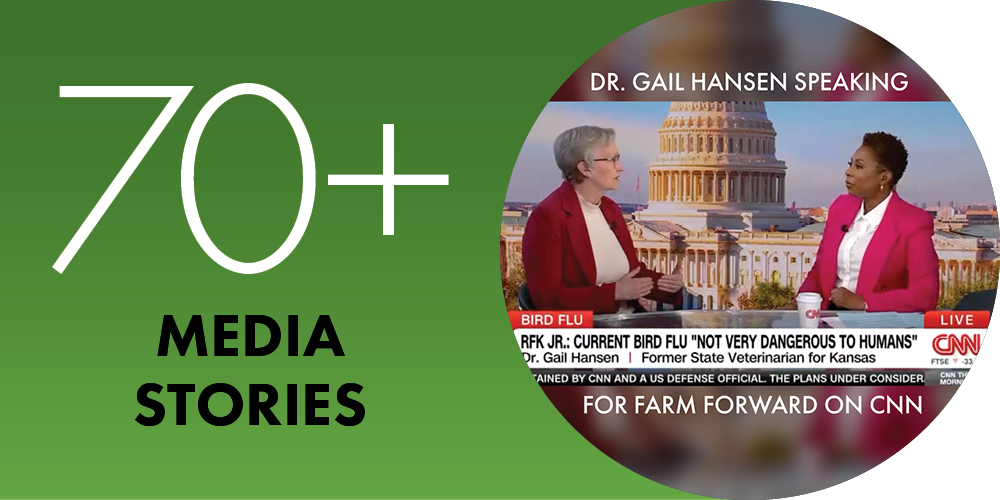 70+ media stories inspired by or featuring content from Farm Forward, in outlets including leading newspapers and magazines, local radio and television news shows, and factory farming industry publications. In 2024 we placed 34 stories, and in 2025, 72, an increase of over 100 percent.

620+ institutions, such as Harvard Business School, NYC Public Hospitals, and Bon Appétit Management Co., transformed their dining policies and operations to serve more plant-based foods and/or fewer factory-farmed products through Farm Forward’s in-house and partner programs, including the Better Food Foundation’s DefaultVeg initiative, by 2025’s end.

123 percent increase in the number of annual unique users of our website since 2023, from 69K to 154K, with visitors exploring topics such as animal welfare labels, bird flu, foodborne illness, antibiotics, humanewashing, litigation and legislation, while the number of clicks and other user-initiated events grew to 742K, a 110 percent jump.
35+ villages in India. Through grants, we provided free and subsidized veterinary care and animal welfare education to more than 35 villages in India in 2025. This initiative relieves animal suffering while supporting research on factory farming that informs our global work. By serving hundreds of farmers and thousands of animals, it helps sustain traditional, higher welfare farming practices and builds knowledge to advance more humane, farmer-friendly, and sustainable Indian agriculture.
 2.9 million views on new media platforms (including TikTok, Reddit, YouTube, Twitter, Instagram, Threads, and BlueSky) of posts and stories about Farm Forward’s work on humanewashing, public health, climate, environment, and more, not counting shares and reposts, in 2025.
 $1.2 billion in annual food spend impacted by the Good Food Purchasing Program (GFPP) across 98 public institutions. A sample of 16 shifted demand from conventional (lowest welfare) meat, dairy, and eggs by purchasing more than 960,000 pounds of higher welfare certified products. We co-led GFPP 3.0’s launch, with stronger plant-based defaults; as data from more institutions comes in, we expect to see GFPP’s “less and better approach” spare millions of animals from factory farming’s worst harms.
Media Highlights
Earned Media Links Food Crises to Industrial Animal Ag
This year, Farm Forward propelled stories about industrial animal agriculture to places they rarely reach. While many Americans remain disconnected from where their food comes from, coverage of our work across major outlets made it harder to ignore what happens inside factory farms—and how those conditions shape everything from public health to climate resilience. More than ever before, reporters relied on our research to explain why so many of the crises dominating the headlines trace back to the same underlying system: factory farming.
Our work on bird flu was particularly effective at reaching new audiences. The New York Times, The Hill, and Newsweek drew on our findings to show how H5N1 continues to spread through overcrowded, genetically fragile flocks and how federal indemnity payments have repeatedly rewarded repeat offenders. The Los Angeles Times highlighted the millions of dollars paid to dairies struck by the virus, and raised questions about why American tax dollars provide ongoing bailouts to industrial dairies even when they do nothing to mitigate disease or prevent reinfection, with some dairies receiving as many as six bailouts in the time period studied. Subsidizing industry practices that spread bird flu leaves workers and the public vulnerable and perpetuates widespread animal suffering. An op-ed in The Hill by our executive director Andrew deCoriolis and expert veterinary epidemiologist Dr. Gail Hansen further sharpened the point: these outbreaks are not inevitable accidents but predictable consequences of a system built for scale, not safety. Our media strategy not only raised public awareness but helped catalyze bipartisan interest in USDA indemnity reform—a legislative effort we’re pursuing with key Senate offices, including Senator Cory Booker of New Jersey and Senator Jack Reed of Rhode Island, who introduced Senate bill S.1904, the “Ending Taxpayer Support for Big Egg Producers Act,” earlier this year.
Our investigation into salmonella contamination achieved even more widespread coverage. More than 20 articles in The L.A. Times, San Francisco Chronicle, CNET, Food Safety News, and other outlets reported on our analysis showing widespread salmonella contamination in poultry sold by leading brands at major grocery chains. The stories underscored the same structural failures visible in the bird flu crisis: animals bred to grow too quickly, crowded barns where pathogens thrive, and a regulatory framework that legally allows contaminated meat to reach consumers.
Building on our exposure of antibiotic residue in “No Antibiotics, Ever” beef sold at Whole Foods, which led to an ongoing class-action lawsuit against the company, our work uncovering antibiotic misuse continued to gain traction. National coverage, from USA Herald to The Cool Down and conservative radio outlets, illustrated how misleading “Raised Without Antibiotics” claims mask widespread industry deception.
What surprised us was how readily these stories crossed into industry circles. Our salmonella findings were covered by Food Safety News, whose primary audiences are industry food safety professionals and regulators, and Poultry Times, a publication not known for amplifying critiques of factory farming. Meanwhile, The Cattle Range, an outlet also typically used to reinforce industry narratives, covered our investigation of antibiotic misuse. Together, these unusual stories signal that our investigation raised these issues to a level that the problem could not be ignored by industry actors.
While food safety and labeling dominated much of the coverage, our environmental work reached new audiences through national reporting on manure-based biogas. Our reports Gaslit by Biogas: Big Ag’s Reverse Robin Hood Effect and The ‘Biogas’ Plot: Fueling Factory Farms in the Midwest documented how digesters entrench factory farming, inspiring a widely read Vox feature challenging the notion that biogas is a climate solution at all. By highlighting how subsidies flow to the largest and most polluting dairies, reporters echoed our warning that climate policy cannot succeed while reinforcing the industrial systems driving the problem.
Media Highlights
Expanding Our Reach Through New Media
While we have a significant track record of securing mainstream media coverage, younger demographics are increasingly relying on nontraditional media sources. To capture this audience, this year we pursued an additional approach with tremendous promise: partnering with influencers and digital creators who already have the trust and attention of some of the communities we’re trying to reach. In November, we launched our first paid campaigns with firms that specialize in new media storytelling, and the results were immediate: millions of views, high engagement, and thousands of people actually taking action off-platform.
Videos created by trusted voices—including videos by “Politics Girl” widely shared on TikTok and other platforms that broke down how salmonella outbreaks and food safety directly relate to factory farming—reached audiences we could never have accessed through traditional media alone, contributing to a 25 percent increase in our audience across platforms. The three videos released via this partnership so far garnered close to 1.3 million views, resulted in more than 17 thousand signatures on petitions to USDA, and brought in hundreds of new small-dollar donors whose contributions will help drive this work forward. We are optimistic that building long term relationships with networks of influencers will pay dividends in shaping public opinion and building political momentum. The challenge: building such relationships requires significant, sustained marketing budgets to scale.
Our content also reached new heights on user-driven platforms. Our salmonella reporting led to Reddit’s #1 posts of the day on r/Health and r/USFoodSafety, and #4 posts on r/PublicHealth and r/News, leading to more than 1.5 million views of the poultry salmonella stories on that platform, the comment sections filled with people demanding answers about why food corporations and USDA are actively endangering public health.
The cumulative impact of this year’s coverage across traditional media, digital storytelling, and user-driven platforms signals a powerful shift. Farm Forward is expanding the narrative so that factory farming is increasingly understood not only as an animal welfare issue, but as a driver of disease risk, environmental harm, and regulatory failure. Through rigorous research and sustained media engagement, we are helping ensure that the national conversation reflects the true costs of industrial agriculture— and the urgency of replacing it with something better.