The Antibiotics Behind Your Thanksgiving Turkey
If you’ve ever given a child pink amoxicillin for an ear infection, or taken doxycycline after a tick bite, you’ve relied on the same two drug families that now make up most of the antibiotics sold for the U.S. turkey industry.
A new Farm Forward analysis of federal and industry data finds that drug companies now sell more medically important antibiotics for the turkey industry, pound for pound, than at any point in the FDA’s records. About 9 in 10 kilograms sold for turkeys in 2024 were penicillins and tetracyclines, the drug families that include amoxicillin and doxycycline.
That should worry anyone sitting down to Thanksgiving dinner, whether or not there’s turkey on their plate.
What comes home with your turkey
The real danger is what the drugs leave behind. Every dose gives bacteria in a turkey’s gut a chance to adapt. The bacteria that survive multiply, spread through the flock, and can end up on the meat.
That has already happened. From 2017 to 2019, a drug-resistant strain of salmonella linked to raw turkey sickened 358 people in 42 states and Washington, D.C., sending 133 to the hospital. Investigators found it in live turkeys and in raw turkey from 38 different plants. About half of the outbreak bacteria tested carried genes linked to resistance to ampicillin, a penicillin, and about a third to tetracycline, the same drug families that dominate turkey antibiotic sales.
Thanksgiving is one of the biggest days of the year for handling raw poultry. Cooks thaw the birds, rinse them, stuff them, and wipe their hands on the same towel. Drug-resistant infections already kill an estimated 50,800 people in the U.S. every year, according to the CDC. And when a resistant infection hits, the drugs doctors reach for, like the amoxicillin in your medicine cabinet, may not work.
Everyone else cut back. Turkey companies didn’t.
In 2017, the FDA stopped allowing medically important antibiotics to be used just to make farmed animals grow faster. Compared with 2016, the year before that change, antibiotic sales per kilogram of animal are down 13 percent for pigs, 17 percent for cattle, and 55 percent for chickens. For turkeys, they’re up 14 percent, and they jumped by a third in a single year, from 2023 to 2024.
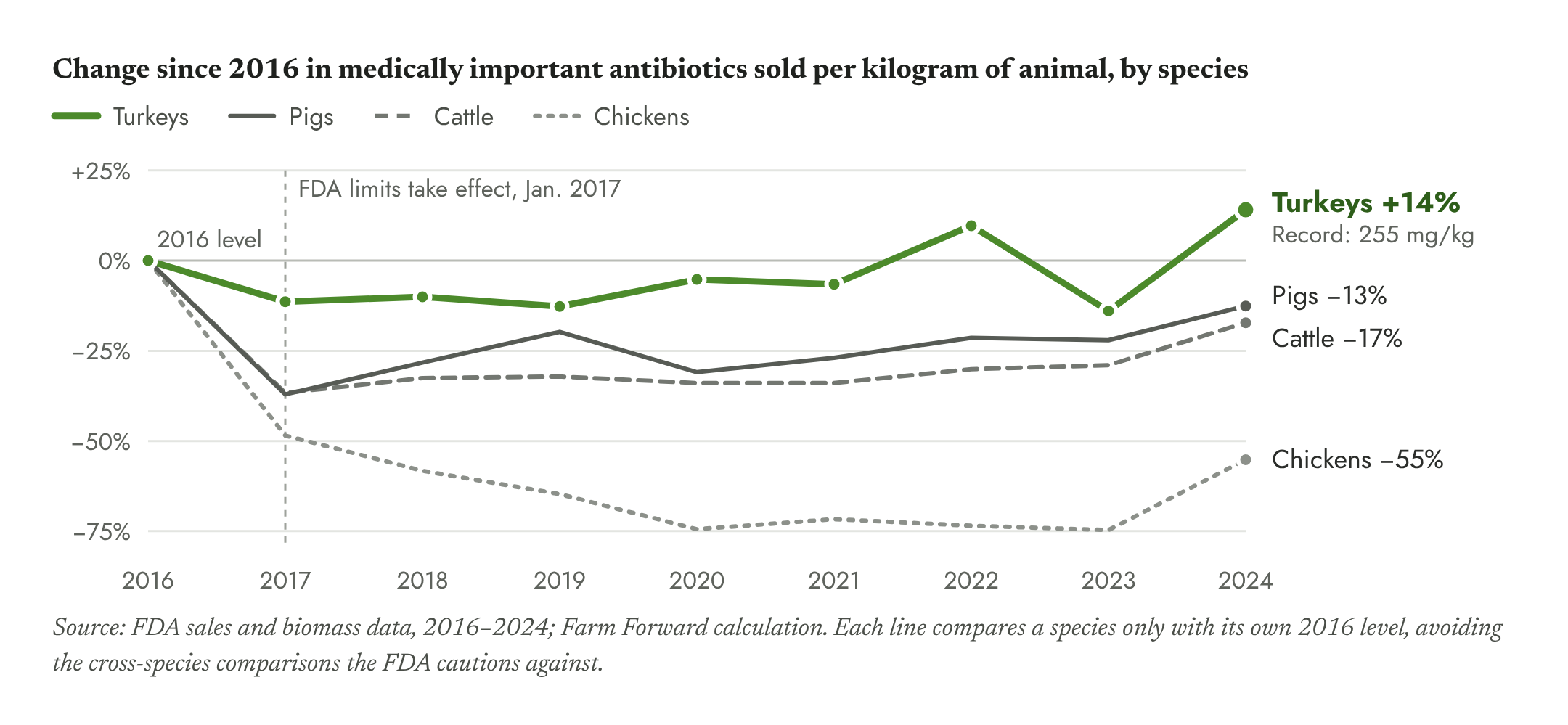
In 2024, more antibiotics were sold per pound of turkey produced than for pigs, cows, or chickens: about 146 milligrams, compared with 109 for pigs, 108 for cows, and 6 for chicken. Turkey makes up 5 percent of meat and poultry production but 11 percent of the medically important antibiotics sold for farmed animals.
A bird built to get sick
The vast majority of turkeys on American tables are Broad Breasted Whites. These birds have been genetically manipulated to grow about twice as heavy at the same age as turkeys in the 1960s. Many struggle to walk, and they’re so heavy that natural mating is difficult, so the industry relies almost entirely on artificial insemination.
They spend their lives packed into crowded barns, standing on litter that builds up with their own poop. In one USDA survey, about 4 in 10 turkey farms reported a bacterial skin disease, and studies point to crowding, dirty litter, and poor hygiene as risk factors.
These aren’t healthy animals who are being given drugs they don’t need. They’re animals made sick by the way they’re bred and raised, kept going long enough to reach slaughter weight with the help of antibiotics.
“It’s the virus”
The turkey industry blames the rise on a respiratory virus that has spread through U.S. flocks, along with the bacterial infections that follow it. Antibiotics can’t treat the virus itself, only those secondary infections. And even veterinary guides say good ventilation, more space, and cleaner litter make the disease much less severe.
British turkey farmers have lived with the same virus since the 1980s. Yet they cut antibiotic use by 82 percent in 10 years. U.S. companies went the other way. In our view, the industry has decided it’s cheaper to keep raising birds in conditions that make them sick, and lean on drugs, than to fix those conditions. A few companies dominate that industry: Butterball and Hormel’s Jennie-O are the two biggest turkey producers in the country.
The FDA has known for nearly 50 years
In 1977, the FDA proposed restricting penicillin and tetracyclines in animal feed to protect them for human medicine. It never followed through, and it withdrew the proposals in 2011. Today, the same drugs can still be fed to animals routinely to “prevent” disease in conditions that cause it. In 2026, the FDA said more than 100 feed antibiotics had no defined limit on how long they could be given.
The World Health Organization calls for an end to that kind of routine use and points to better housing and husbandry instead. In June, Farm Forward and 64 other groups petitioned the FDA to set targets for cutting antibiotic use in every livestock sector. As of October 30, 2026, the agency hadn’t responded.
What you can do
- Tell the FDA to answer the petition and set reduction targets by posting a comment.
- Share this with anyone you know who’s planning to cook a turkey this year.
- Rethink the centerpiece. Virtually all turkeys in the U.S. are raised on industrial farms. For many shoppers, the best alternative is a plant-based main dish.
For the full data, read the fact sheet, The Most Medicated Bird on the Table.