The Salmonella Markup: What’s Really Behind Whole Foods’ 365-Brand Chicken
Whole Foods’ 365-brand chicken is built on the promise of “better meat,” claiming traceability, animal welfare, and “no antibiotics, ever.” It would be reasonable to assume that “better” also means “safer.”
Farm Forward’s latest investigation found that this is not the case. In August 2026, we traced 247 packages of 365-brand raw chicken at 30 stores across the country to the plants that processed them. We cross-referenced those plants with USDA’s salmonella testing data and found that 98.4 percent of 365-brand chicken came from plants where the most dangerous strains make up the majority of salmonella-positive samples. Most of this chicken is processed at Perdue plants that are the same plants processing chicken sold at mainstream supermarkets like Walmart and Kroger. Comparing prices between Whole Foods and mainstream retailers revealed Whole Foods charging a premium of up to 45.7 percent for chicken from the same plants.
1. More than a quarter of 365-brand chicken came from plants that failed federal salmonella standards.
Half (3 of 6) of the slaughter plants supplying 365-brand chicken failed USDA’s salmonella standard every month for the past year. These plants supplied 27.1 percent of the chicken we sampled, and two of them rank among the worst in the country: Perdue’s plant in Georgetown, DE, ranked #3 for contamination in 2025, and Pitman Farms’ plant in Sanger, CA, ranked #2. (Pitman also sells chicken under the Mary’s Chicken brand, which is also available at Whole Foods.)
Perdue’s Georgetown plant is one of the dozens of plants where ProPublica found the multidrug-resistant strain of Salmonella Infantis behind a 2018 outbreak that sickened 129 people and killed one. (Infantis is one of the three strains in the poultry industry most likely to make people seriously ill.) The Georgetown plant also supplied 33 of the 39 packages (84.6 percent) of 365-brand ground chicken in our sample.
In our previous research, we found a similar record of contamination in Costco’s chicken supply chain.
2. The most dangerous salmonella strains dominate every plant.
Three high-virulence strains—Salmonella Infantis, Salmonella Enteritidis, and Salmonella Typhimurium—are responsible for the most severe illness, hospitalization, and death, and all three are found regularly in the poultry industry. Farm Forward’s earlier report found that these strains are taking over salmonella in poultry, growing from roughly a quarter of positive samples in 2014 to more than two-thirds (67.9 percent) in 2025.
At the plants supplying 365-brand chicken, these three strains made up between 60 and 100 percent of positive samples. This was true not only for plants that consistently failed the USDA’s salmonella standard but also for plants that have consistently passed it. Perdue’s Cromwell, KY plant, for instance, earned the best rating in our sample, yet every positive sample there was Infantis. This highlights a flaw in USDA’s performance standards: the agency bases its ratings only on how often chicken tests positive, not on which strains are found at the plant (despite the fact that it does collect this data).
3. Worse, the bacteria found at these plants resist drugs critical to treating human illness.
At every plant in the 365-brand chicken supply chain, at least 64.8 percent of positive samples were antibiotic-resistant, and at least a quarter were multidrug-resistant. At two Perdue plants, 100 percent of positive samples were multidrug-resistant. Antibiotic resistance may seem like an abstract threat, but the World Health Organization (WHO) and the Centers for Disease Control and Prevention (CDC) name it as one of the greatest global public health threats of our time. When bacteria develop resistance to one or more antibiotics that are important for treating human disease (as classified by the WHO), options for treatment become limited, and when resistance develops to multiple drug classes, treatment can fail altogether. As the problem escalates, this means that common infections that have been easy to treat since the advent of antibiotics, like an ear infection, urinary tract infection, or an infected scrape, could become deadly again. This isn’t a problem limited to a few bad plants; it’s one of the hidden health risks of industrial poultry production more broadly.
At the same time, Whole Foods, Perdue, and Pitman Farms all sell “No Antibiotics Ever” chicken. But that label describes how a bird was raised, not whether salmonella on the meat resists critical antibiotics. Consumers who choose antibiotic-free meat to avoid fueling the antibiotic-resistance crisis may unknowingly be supporting companies whose plants carry some of the most drug-resistant salmonella in the country.
4. Whole Foods chicken is, in most cases, Perdue chicken.
In our sample, 92.3 percent of 365-brand chicken was processed at Perdue plants. In 14 of the 19 markets where we audited both a Whole Foods and a nearby mainstream retailer, the two stores sourced chicken from at least one of the same Perdue plants. Shoppers can trace where 365-brand chicken is processed, but not where the birds were raised. Although Whole Foods claims “traceability to farm or ranch” in its meat quality standards, when we asked for farm-level sourcing for 365-brand chicken, the company said it couldn’t provide that information. Even without farm-level data, we know that salmonella often spreads between birds on the slaughter line, which makes the processing plant a key point where risk is amplified.
5. Shoppers pay a premium for chicken from the same Perdue plants that supply Walmart, Kroger, and other mainstream retailers.
We compared pricing for 365-brand chicken and Perdue chicken at nearby mainstream retailers, matching product type, organic or conventional claims, and processing plant. Whole Foods charged up to 45.7 percent more, and 19.6 percent more on average. In Minneapolis, for instance, Whole Foods charged an average of $5.74 a pound for 365-brand boneless thighs, while a Walmart 15 minutes away charged $3.94 a pound for Perdue thighs from the same plant. In 12 of our 13 direct product comparisons, Whole Foods charged more; in the other, it charged the same price. It never charged less.
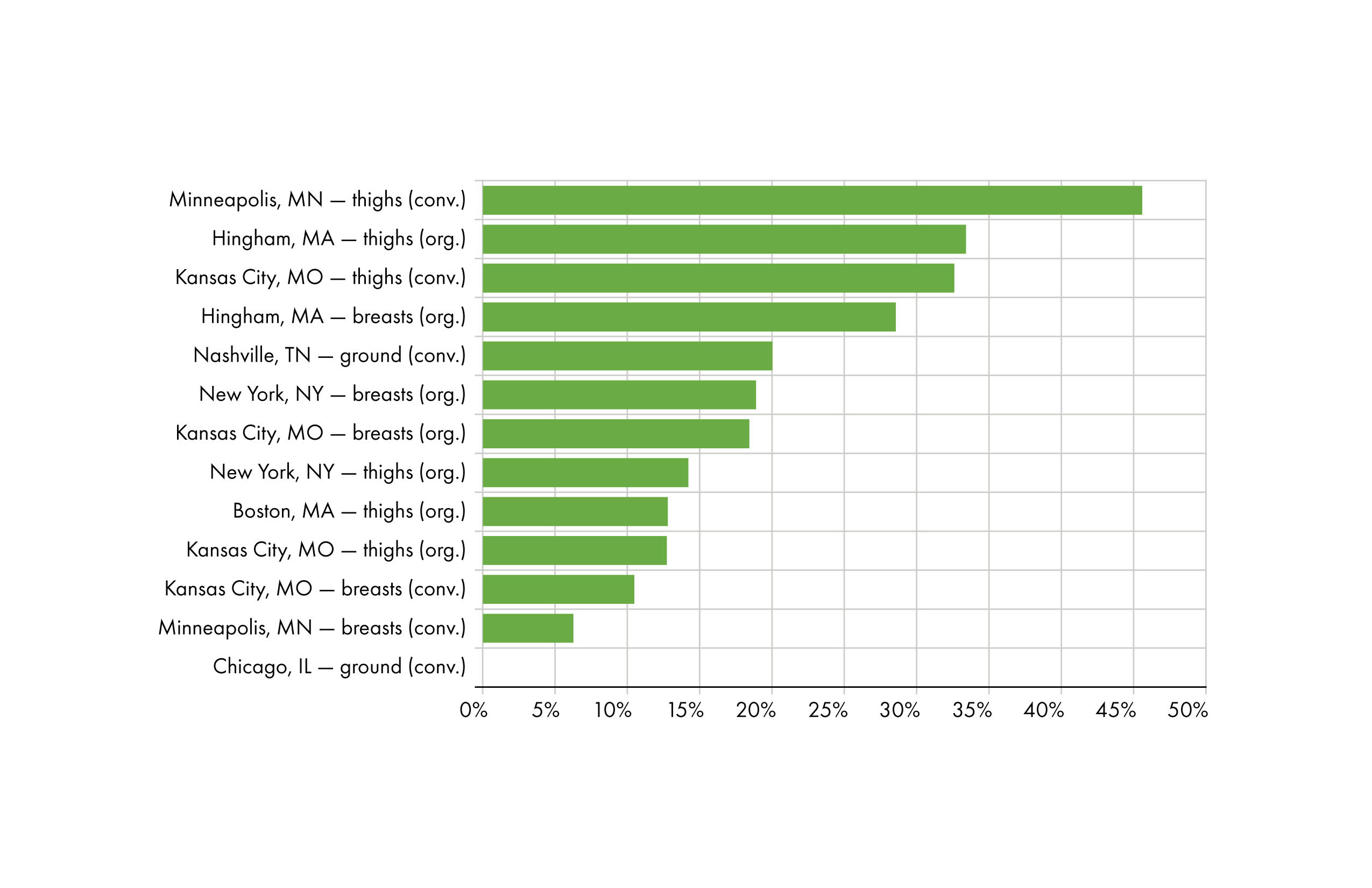
In other words, paying more for Whole Foods chicken doesn’t buy lower risk. Whole Foods would likely argue that its premium reflects factors unrelated to where and how a bird is slaughtered. And there was a time when Whole Foods could have claimed a genuinely higher cost of production. In 2016, the company made a pledge to phase out the fast-growing chicken breeds raised and sold by companies like Perdue. This would have added real cost (projected by researchers to range from 11 to 25 percent more). However, Whole Foods broke that promise, instead continuing to sell fast-growing breeds that are much cheaper to raise. So the premium doesn’t reflect the one cost that could have justified it. What’s more, a premium that ranges from zero to 45.7 percent can’t be explained by any single cost of raising birds; if a factor like breed or housing added substantial cost, the premium would be consistent across markets.
What needs to change
- Whole Foods should disclose full traceability information at the point of sale (or, at minimum, when consumers ask for it) and stop sourcing chicken from plants with dangerous salmonella contamination.
- USDA should factor strain and antibiotic-resistance data, which it already collects, into plant ratings; set real consequences for plants that repeatedly fail the standard; and reinstate a rule it proposed in 2024 and withdrew in 2025. That rule would have classified raw poultry with high levels of certain dangerous salmonella strains as adulterated, allowing USDA to prevent it from going to market.
- Consumers can request traceability information from Whole Foods and press the company to be more transparent. In the absence of any other information, they can look up a package’s plant number in USDA’s publicly posted contamination ratings before they buy (see Farm Forward’s guide to looking up plant numbers), or, safer still, avoid raw chicken entirely.
Read Farm Forward’s full report, “Salmonella Sold at a Premium: The ‘Better Meat’ Behind Whole Foods 365-Brand Chicken,” for the complete findings. To learn more about Whole Foods’ broken breed promise, read “The Root of the Problem: How Whole Foods Abandoned Its Promise on Chicken Genetics.”