The Butterball Problem: How Big Poultry Is Spreading Salmonella to Your Thanksgiving Table
Thanksgiving is supposed to be a time of warmth, gratitude, and home-cooked meals shared around the table—not a trip to the emergency room. Yet the turkey at the center of America’s favorite holiday may come with a hidden danger: salmonella.
And the biggest brands—including Butterball, the household name synonymous with Thanksgiving—are among the worst offenders.
Inside the Salmonella Outbreaks Plaguing U.S. Turkey Production
Salmonella is the leading cause of death from foodborne illness in the U.S. Each year, it sickens an estimated 1.28 million Americans, sending tens of thousands to the hospital. Shockingly, 1 in every 20 cases can be traced back to contaminated turkey.
The contamination crisis isn’t just bad luck—it’s baked into the way industrial turkeys are raised. 99.8% of birds come from factory farms, characterized by crowded, filthy sheds packed with tens of thousands of turkeys standing in their own waste. These conditions create perfect breeding grounds for pathogens like salmonella.
But it goes deeper: over decades, the industry has genetically modified turkeys through selective breeding to maximize growth, not for health, welfare, or resilience. The result is that, in addition to causing widespread suffering from chronic health problems, birds with weakened immune systems are more prone to infection and more likely to carry bacteria that can make people sick.
What Big Poultry Hides: USDA Reports Expose Widespread Salmonella Contamination
An investigation by Farm Forward that analyzed USDA inspection reports reveals just how widespread the problem is—and how deeply entrenched it’s become. The findings are grim.
For the last two years, 100% of slaughter and processing plants owned by Foster Farms, Perdue, and Michigan Turkey Producers failed the USDA’s salmonella safety standards. Sixty percent of Butterball’s plants and 67% of Cargill’s plants failed the standard. (Note: Perdue also sells under the Harvestland brand, Michigan Turkey Producers sells under Great Lakes, and Cargill sells under Honeysuckle White and Shady Brook Farms).
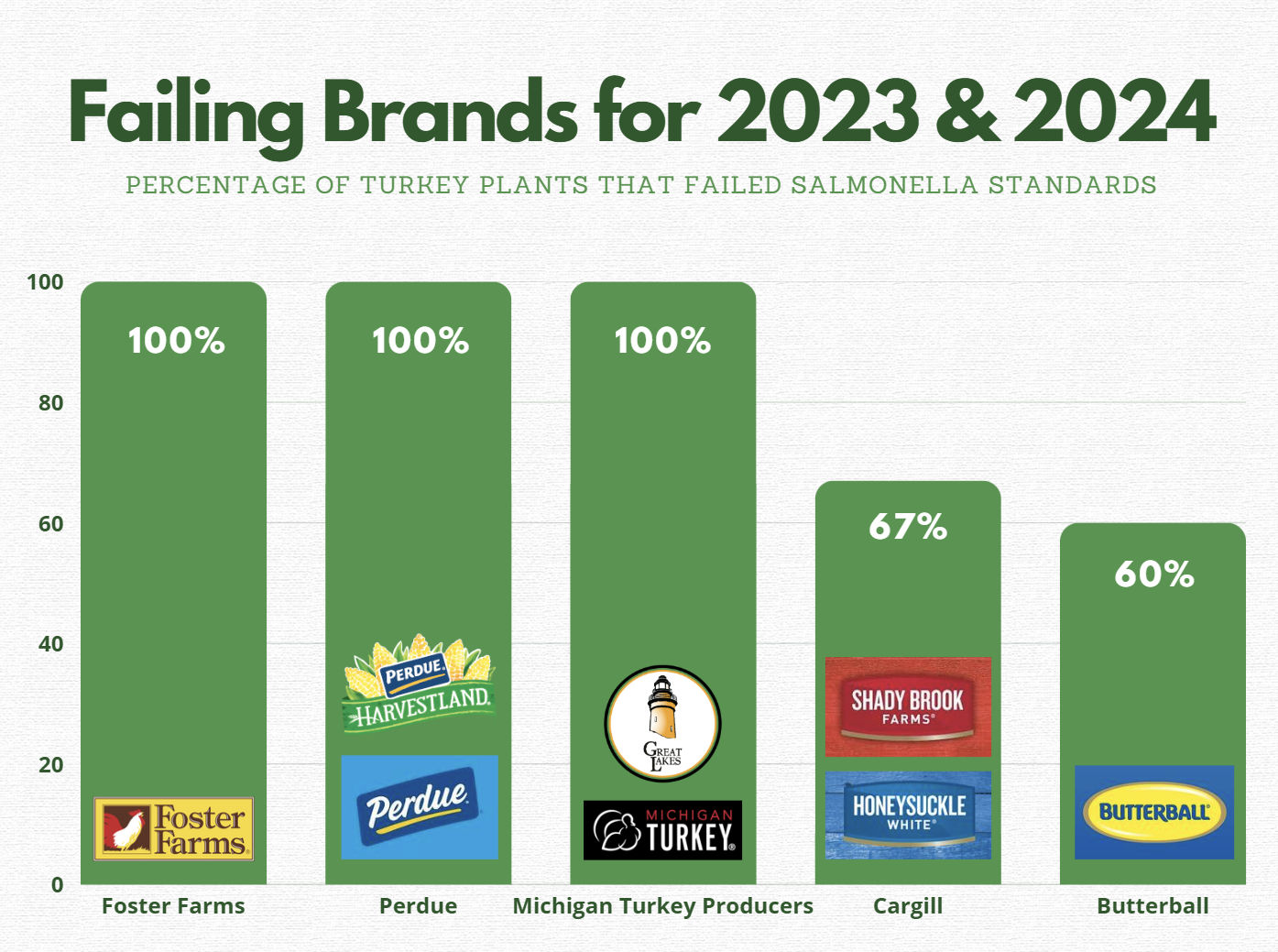
For five straight years, Butterball and Cargill have operated individual plants that failed salmonella safety standards every single month. Perdue’s plants failed 90% of the time on average.
And yet, these companies continue to sell their products without interruption.
Butterball and Cargill supply roughly two-thirds of all Thanksgiving turkeys in the U.S. That means millions of families are likely bringing home birds with salmonella contamination—without knowing it.
The Broken System Behind Salmonella-Contaminated Turkey in Grocery Stores
The staggering statistics about salmonella contamination not only signal an irresponsible industry with a flagrant disregard for public health, but also the federal government’s unmitigated failures to keep contaminated meat out of your grocery cart.
Although USDA sets standards for salmonella contamination, even when turkey producers “meet” USDA salmonella standards, they allow for high rates of contamination: 1 in 14 whole turkeys can test positive for salmonella, and 1 in 7 ground turkey samples can be contaminated—and still pass.
And if a plant fails the standard? There’s no penalty. USDA cannot force recalls or stop sales of contaminated products, even from companies that fail continuously. Consumers are left to shoulder the risk.
The Future of Food Safety: Holding Butterball and Big Poultry Accountable
Thanksgiving should celebrate abundance and gratitude—not expose families to unnecessary danger. The “Butterball problem” isn’t just about one company—it’s a symptom of an industry that prioritizes profit over public health and a government that fails at regulating it.
It’s time to hold major producers accountable and call on the federal government to protect American consumers. What you can do:
- Demand reform by insisting that USDA pass a proposed rule on stricter salmonella safety regulations.
- Choose plant-based foods this Thanksgiving, avoiding the risk of salmonella-contaminated turkey entirely.
- Stay informed by reading Farm Forward’s full report on salmonella in the poultry industry.