Whole Foods is Charging Premium Prices for Sh*tty Walmart Chicken
Whole Foods has built its brand on the reputation that its meat is better—from animals who were better raised, on better farms, all of which produces products that are better for you. Roughly 30 million Americans shop at Whole Foods and if you buy meat, you’re paying a significant premium for that reputation. But a closer look at what’s actually inside the chicken package tells a different story.
The chicken Whole Foods is selling under its 365 house brand? It’s Perdue. The same Perdue you can buy at Walmart for a fraction of the price.
Here’s the Proof
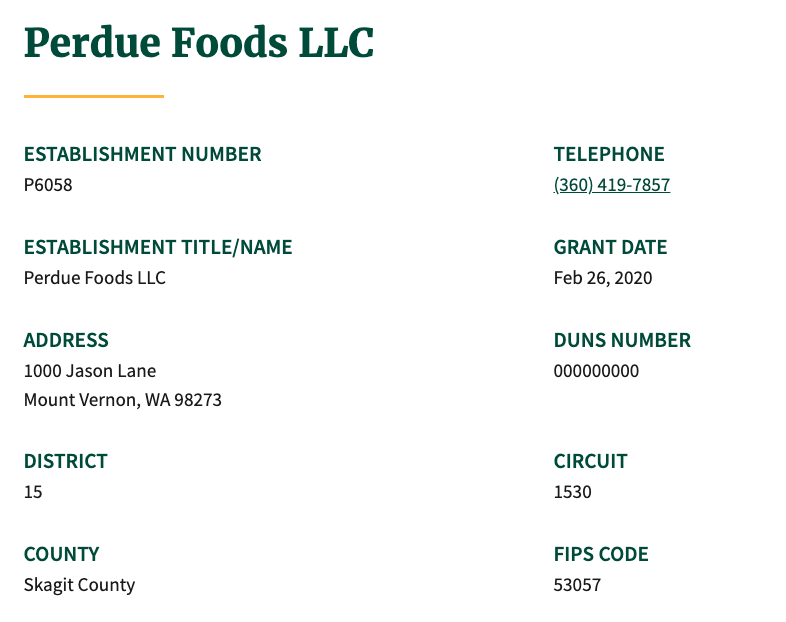
Every package of chicken sold in the US is required to carry an establishment number, which is a code that identifies exactly where the animal was slaughtered and processed. For chicken and turkey, that number begins with a “P.” Look it up in the USDA’s Meat and Poultry Inspection database, and you’ll find exactly which facility and company produced what’s in your grocery bag.
We recently went to Whole Foods in Oregon and found these 365 branded boneless skinless chicken breasts and found this on the label:
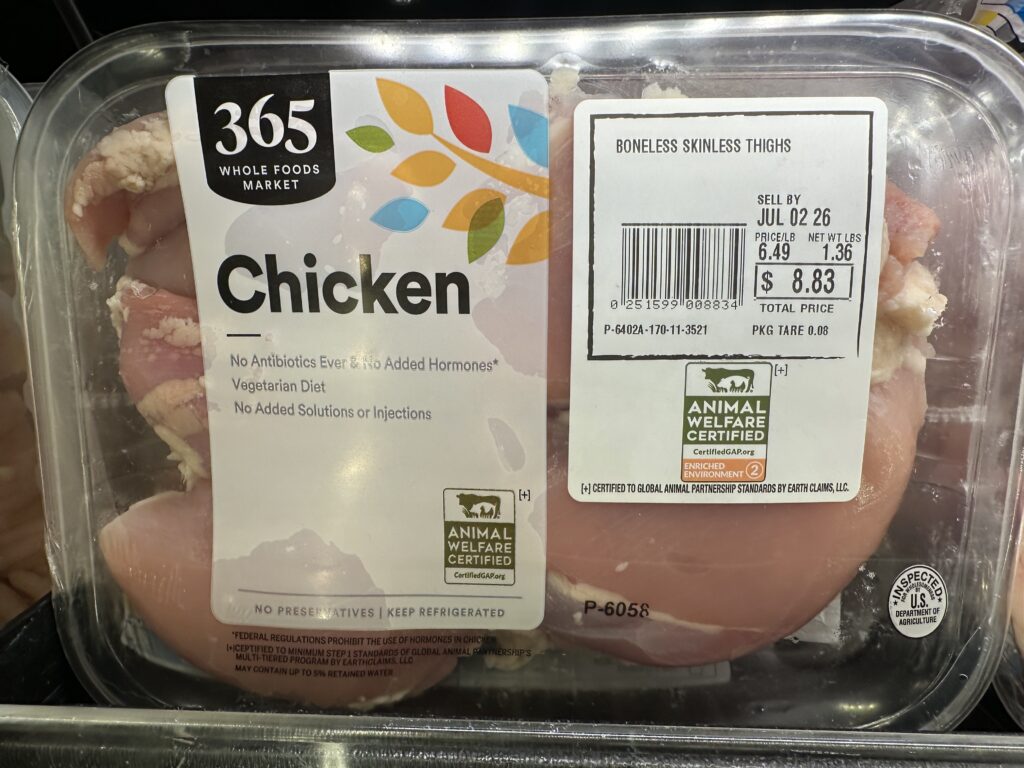
The code listed is “P-6058,” an establishment number that traces directly to a Perdue processing facility in Washington state.
At a Whole Foods in Pittsburgh PA we found another 365 brand chicken with another Perdue product, this one from a slaughterhouse in Milford Delaware (P1318).
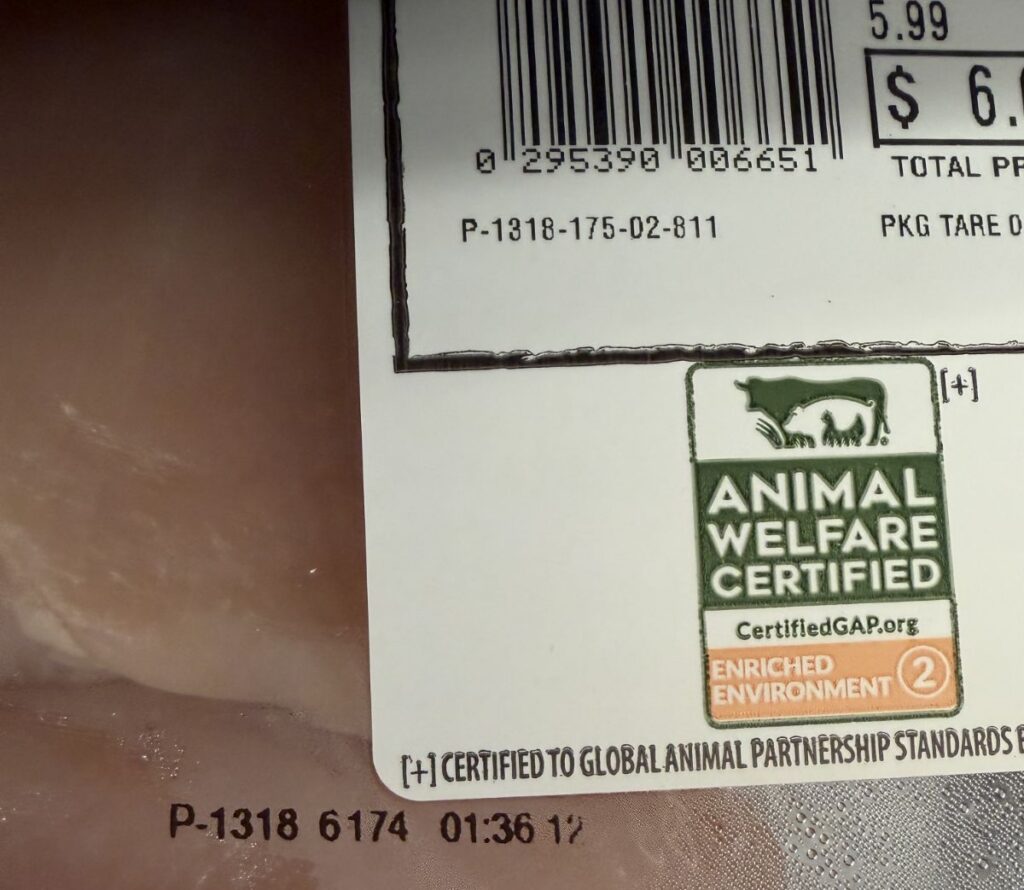
At the Whole Foods stores in Oregon and Pennsylvania, the 365 Brand chicken produced by Perdue was being sold for $6.49/lb.
Now here’s the price comparison—Perdue Harvestland brand boneless skinless chicken breasts, sold online by Walmart for $3.82 a pound.
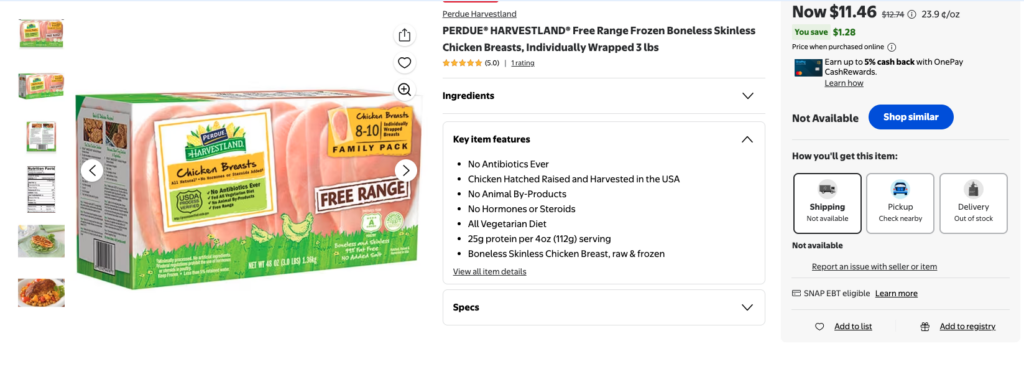
That’s a 70% premium for the same chicken, from birds raised in virtually the same conditions, sold by the same company, just under a different label.
Even if you think Walmart can sell products cheaper than anyone else, other mid-tier regional retailers like QFC are selling the same Perdue chicken for 19 percent less per pound than Whole Foods chicken.
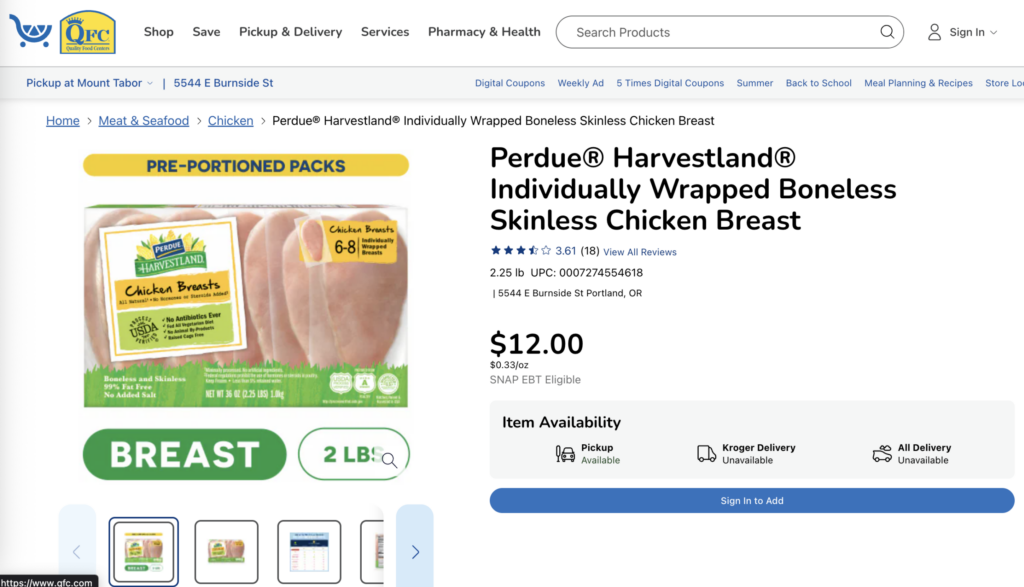
So what exactly is that premium buying you? Not a better bird, not a safer product, and not better meat. Here’s what it’s actually buying.
Why Industrial Chicken Is a Problem
That Perdue chicken, whether it’s sold at Whole Foods, Walmart, or anywhere else, comes from the same fast-growing Cornish Cross breeds, marketed under names like Cobb 500 and Ross 308, that make up more than 99 percent of the chicken industry. These birds are genetically modified through selective breeding to reach slaughter weight in roughly six weeks, a pace their bodies cannot reliably support. The result is chronic lameness, joint deterioration, heart failure, and respiratory distress at rates with no parallel in the heritage breeds that were standard a generation ago.
Whole Foods has known this for more than a decade. In 2016, it made a public commitment to phase out fast-growing breeds across its supply chain by 2030. Farm Forward’s investigation found that Whole Foods has since quietly walked that back, stripping breed requirements from more than 95% of its chicken products in the latest update to its certification standards. You can read more about the reversal in detail here.
Perdue Has Serious Food Safety Problems
Perdue has one of the worst food safety records among major U.S. poultry companies. USDA’s Food Safety and Inspection Service (FSIS) tracks salmonella contamination rates across poultry processing plants and publishes performance data. Perdue facilities have repeatedly appeared among the poorest performers, with contamination rates well above industry averages at multiple plants.1 According to USDA FSIS salmonella testing, the plant in Mount Vernon, Washington that supplies Whole Foods 365 brand chicken in Oregon has received a Category 3 failing rating in the most recent testing.2
Salmonella sickens an estimated 1.35 million Americans annually, hospitalizes 26,500, and kills roughly 420. A significant share of those cases are linked to poultry. When you buy chicken from a company with a documented contamination problem, you are absorbing that risk, whether the label says “Perdue” or “365.” Salmonella is endemic in Perdue birds because the crowded conditions expose them to bacteria that breeds in their own waste. When we say it’s sh*tty chicken, we literally mean it’s chicken that’s covered in sh*t.
The Meat Quality is a Problem Too
Beyond animal welfare, conventional fast-growing genetics are also associated with a long list of meat quality defects that affect consumers directly. So called “white striping” is a muscle tissue defect in which white fat deposits streak through breast meat. It is associated with the rapid muscle growth of fast-growing breeds and affects a significant and growing proportion of conventional chicken breasts.3 Affected meat has lower protein content, higher fat content, and altered texture compared to unaffected tissue.4
You don’t have to take our word for it. Whole Foods’ own marketing photo for its organic 365 chicken breasts shows visible white striping, right there in the picture.
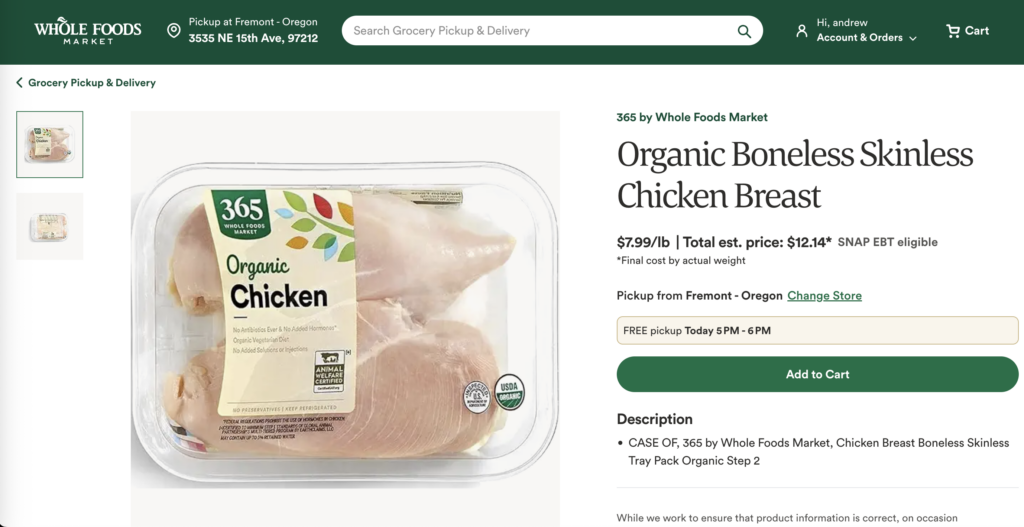
“Woody breast” is another common defect, where the muscle develops an abnormally hard, rubbery texture from fibrosis and degeneration of the tissue. Affected portions are often inedible or need heavy processing to mask. In some conventional fast-growing flocks, studies have documented woody breast in more than 50 percent of fillets.5
These are well-established, peer-reviewed findings, and they affect anyone who eats conventional chicken. The defects and the growth rate share the same cause—genetics that pack on breast meat in six weeks are also breaking down the muscle tissue itself.
The Bottom Line
Strip away the marketing and what’s left are the simple facts that Whole Foods’ 365 chicken is Perdue chicken, which come from the same fast-growing genetics, processed at plants with the same food safety risks, and prone to the same quality defects as the chicken sold everywhere else—including Walmart. The difference is that at Whole Foods it costs 70% more. The “Quality Standards” Whole Foods uses to justify its prices claim that “better meat is our commitment to you.” For the last ten years, their commitment to improved chicken breeds was a real part of the basis for that claim. It no longer is.
The P number on the package doesn’t lie. The USDA database doesn’t lie. The price gap between a Whole Foods 365 label and the same Perdue product at Walmart or QFC reflects marketing, not better farming or better meat.
Conscientious shoppers paying a premium for Whole Foods chicken deserve to know what they’re actually buying.
Read our full investigation into Whole Foods’ abandoned breed commitment here.
Endnotes
1.
Katie Gillespie, “How the USDA & the US Poultry Industry Fail to Protect Americans from Foodborne Disease,” Farm Forward, accessed July 14, 2026, https://www.farmforward.com/publications/how-the-usda-the-us-poultry-industry-fail-to-protect-americans-from-foodborne-disease/.
2.
USDA Food Safety and Inspection Service, “Salmonella Verification Testing,” dataset, April 27, 2025–April 25, 2026, accessed July 14, 2026, https://www.fsis.usda.gov/sites/default/files/media_file/documents/Dataset_EstablishmentCategories_202606.pdf.
3.
Petracci, Massimiliano, and Cecile Berri, eds. Poultry Quality Evaluation: Quality Attributes and Consumer Values. 1st ed. Amsterdam: Elsevier, 2017.
4.
Vivek A. Kuttappan, V. B. Brewer, J. K. Apple, P. W. Waldroup, and C. M. Owens, “Influence of Growth Rate on the Occurrence of White Striping in Broiler Breast Fillets,” Poultry Science 91, no. 10 (2012): 2677–85;
5.
V. V. Tijare, F. L. Yang, V. A. Kuttappan, C. Z. Alvarado, C. N. Coon, and C. M. Owens, “Meat Quality of Broiler Breast Fillets with White Striping and Woody Breast Muscle Myopathies,” Poultry Science 95, no. 9 (2016): 2167–73;